02 / Methods & Skills

Quantitative methods
& skills.

Many psychological questions involve constructs we cannot observe directly, people whose responses are linked, or experiences that change over time. I use quantitative methods to address these challenges in relationship science and collaborative mental health research.

Choosing an analysis starts with the design.

A speed-dating study contains overlapping impressions, couples provide interdependent reports, and longitudinal research follows the same people over time. Those structures matter for what a model can estimate and what its results mean. I select methods around the design and the substantive question, not the other way around.

I use R for data cleaning, psychometric analyses, multilevel and structural equation models, simulation, visualization, and reproducible reporting. I also develop methodological research, teach statistics, and help collaborators interpret findings.

Methods in practice.

01 / Measurement

Psychometrics & scale development

Exploratory and confirmatory factor analysis, item response theory, reliability and validity assessment, and measurement invariance across groups and partners.

In practice

For the RoCh Scale, I combined item generation and reduction with factor analysis, item response methods, and tests of measurement structure across single people, partnered people, and couples.
View scale preprint ↗
02 / Interdependence

Dyadic & structural equation modeling

Social Relations Models, actor–partner and common-fate models, latent dyadic SEM, and ways of accounting for measurement error and shared variation.

In practice

I used the Social Relations Model in speed-dating research and co-authored a review of latent dyadic SEM. With John Sakaluk, I am also developing Monte Carlo simulations comparing ways to represent individual and shared experiences.

View methods publication ↗
03 / Change over time

Multilevel & longitudinal analysis

Multilevel models, repeated-measures designs, intensive daily diaries, and longitudinal associations in cohort and dyadic data.

In practice

I have analyzed 21-day diary data from romantic couples and longitudinal mental health data at SickKids, including studies of adolescent depression and cognitive functioning.

Explore applied projects ↗
04 / Implementation

R, reproducibility & reporting

Data cleaning, reproducible R workflows, diagnostic checks, simulation, visualization, and clear reporting of effect sizes and uncertainty.

In practice

At SickKids, I conduct analyses, interpret findings, and draft Methods and Results sections. I have also developed and evaluated dating-matching algorithms for the Aphrodite Project and taught R through statistics courses and workshops.

See teaching experience ↗

Research on statistical practice.

Questions about model choice, measurement, and statistical reporting are part of my scholarship. My methodological collaborations include published work on dyadic SEM and multiplicity control, and ongoing simulation research on dyadic measurement.

2025 · SOCIAL AND PERSONALITY PSYCHOLOGY COMPASS

A renewal of dyadic structural equation modeling with latent variables

A methodological review of why latent-variable approaches matter for dyadic research, including their assumptions, advantages, and limitations.

Read article ↗
2025 · CANADIAN PSYCHOLOGY

Multiplicity control in psychological research

A systematic review of how multiplicity is handled and reported in empirical psychological research. The coauthored paper received the Canadian Psychological Association Quantitative Methods Section’s 2025 research award.

Read article ↗
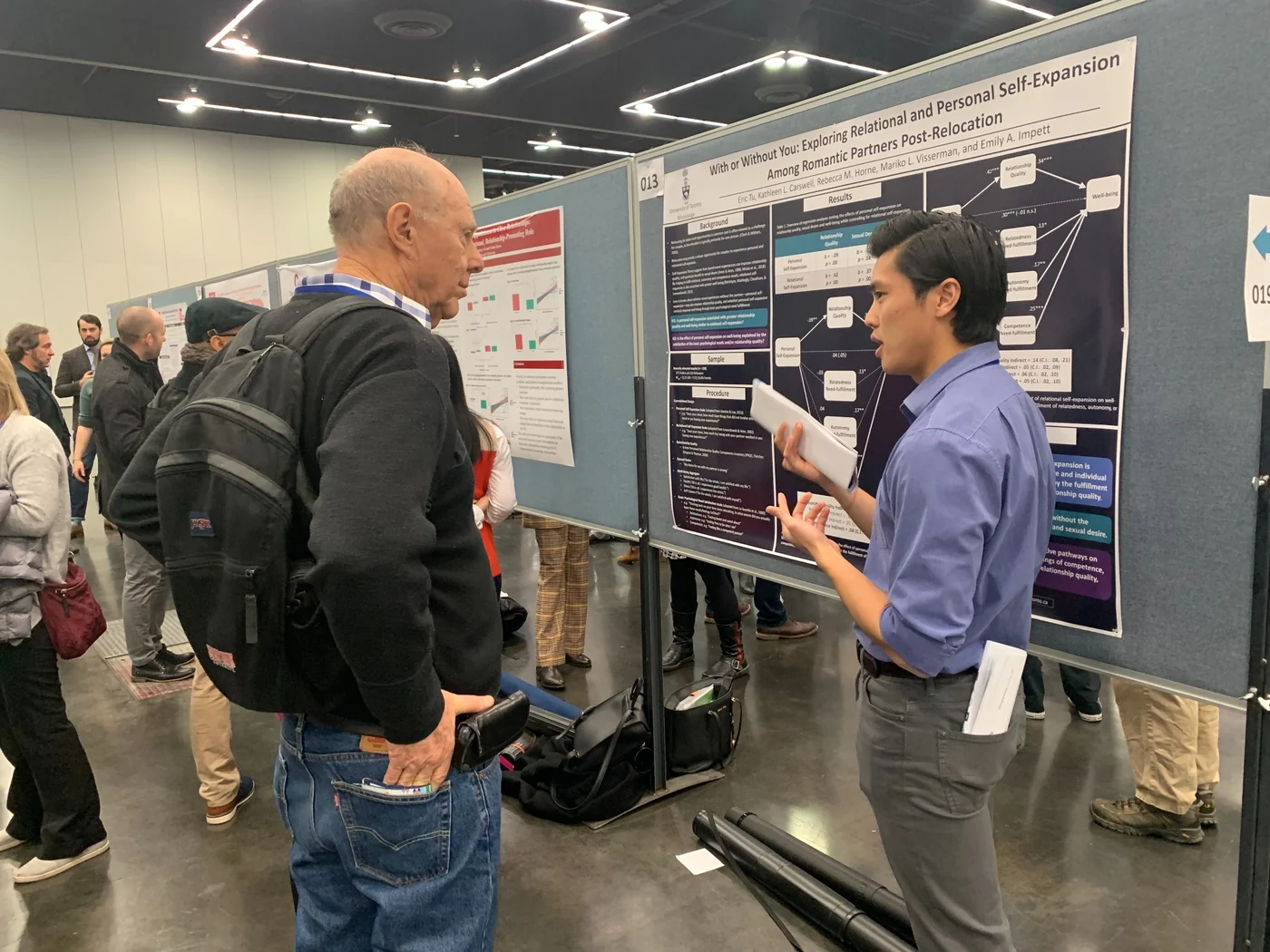
Eric Tu discussing a research poster with a conference attendee
Discussing research at a conference poster session.

From analysis to discussion.

Statistical analysis is also a collaborative process. I aim to make modeling decisions, uncertainty, and limitations understandable to collaborators working with different designs and research questions.

Interested in a quantitative
collaboration?

I welcome research collaborations involving measurement development, interdependent or longitudinal data, statistical simulation, and reproducible analysis.

Start a conversation ↗